


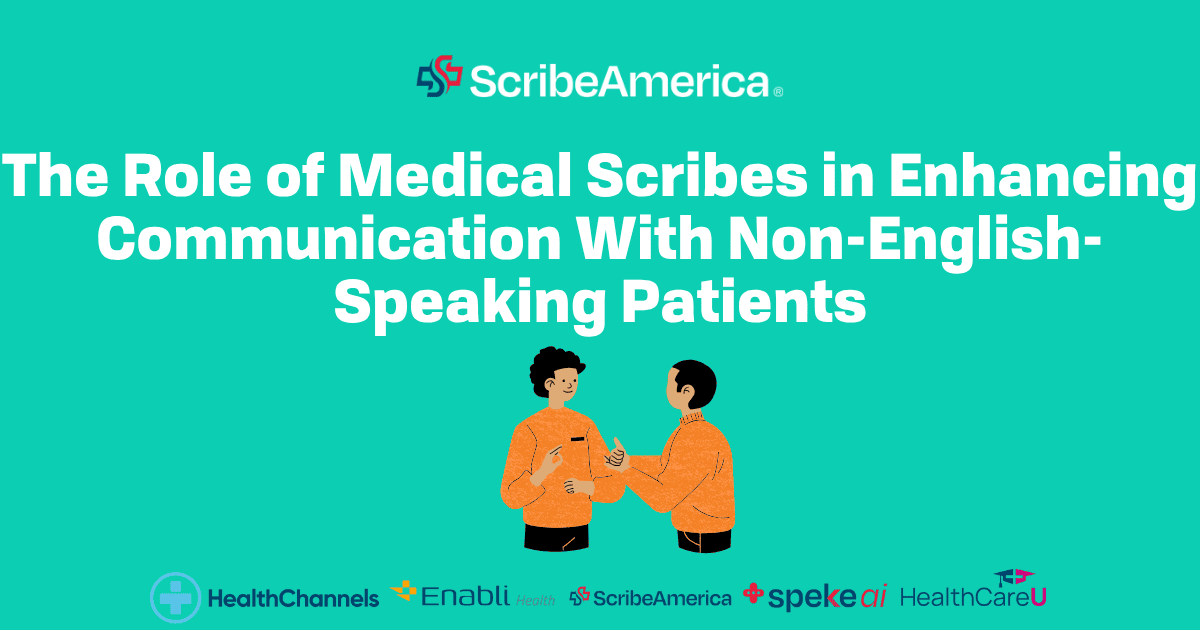


Medical scribes are a vital element of smoothing out communication with non-English-speaking patients. They take over the inputting role, scribing the interaction and enabling physicians to focus purely on patient care – reading the body language, the tone, and listening to the interpreter. This makes visits faster, improves their overall effectiveness, and helps foreign patients feel calmer.
Key Takeaways
- The main communication problem with non-English-speaking patients is the number of tasks the physicians handle simultaneously.
- Medical scribes bridge the gap by removing the administrative burden, enabling physicians to read their patients’ facial expressions & body language and focus on follow-up questions & treatment planning during the visit.
- Bilingual medical scribes add even more value by translating cultural nuances, reducing patient anxiety, and streamlining the overall interaction.
The problem of communicating with non-English-speaking patients
When a non-English-speaking patient visits a clinic, the physician becomes a multi-tasker. They have to navigate between multiple processes repetitively. This has consequences: such visits are longer, and the physician cannot focus fully on providing care. The steps they are typically engaged in are: listening to the interpreter → taking notes → answering the interpreter → waiting for the interpretation and patient response.
This takes important non-verbal communication out of the equation: maintaining eye contact and reading body language. The physician switches context from inputting information into the EHR, analyzing the symptoms, considering treatment options, and ensuring they get all the essential information.
How to communicate with non-English-speaking patients more efficiently with medical scribes
The main problem in communication with non-English-speaking patients is multitasking. Thus, the solution is reducing the number of tasks the physician has to handle. Medical scribes do exactly that.
By taking over the scribing and inputting of information, medical scribes shorten the equation – physicians focus purely on communication and treatment. Instead of taking notes, they can look at the patient, maintain eye contact, analyze their body language, and ask follow-up questions critical for establishing the right treatment. This leads to:
- Improved treatment – physicians are focused fully on the patient, so they can extract more information from the visit in real time. They also get to understand the wider context by seeing facial expressions and body language.
- Higher patient satisfaction – non-English-speaking patients are often stressed out by the visit, especially when waiting for the translation. Maintaining eye contact and showing them that the physician is focused fully on them can relieve this stress and lead to higher satisfaction.
- Quicker visits – since scribing is taking place simultaneously with the conversation, physicians can see more patients each day.
The extra value of bilingual medical scribes
Every medical scribe can increase the effectiveness and efficiency of communication with non-English-speaking patients. But having a bilingual medical scribe in the room brings an even greater advantage.
Beyond just taking notes, bilingual scribes understand the cultural nuances and specific idioms patients use to describe their pain or symptoms – subtleties that literal translation apps or over-the-phone interpreters often miss. They can instantly translate complex medical terminology into accurate EHR documentation without interrupting the flow of conversation. This eliminates translation lag, ensures precise medical charting, and creates a far more empathetic environment where foreign-language patients feel truly understood.
Read more: The Benefits of Being Bilingual in Healthcare Industry
Medical scribes are the key to efficient multilingual patient communication
Smooth, empathetic, and efficient communication is the cornerstone of healthcare. While more difficult with non-English-speaking patients, it’s still within reach with the right adjustments. Physicians appreciate medical scribes for their role in this process – the takeover of paperwork for the sake of better, more direct communication. They don’t just take notes – they bridge the gap between patient care and administration for the sake of better healthcare.
Interested in bridging the gap? Browse medical scribe job openings at Scribe America and start making a difference.