


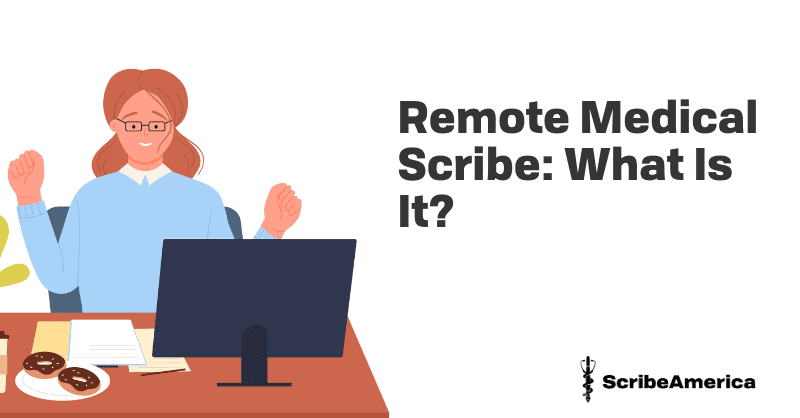


A remote medical scribe, also called a virtual medical scribe, documents patient visits in the electronic health record (EHR) from home instead of the exam room. You join each visit through a secure video or audio connection, or work from a recording, and turn the conversation into an accurate note for the provider to sign. This guide covers how virtual scribing works, the tech setup you need, pay, work-from-home requirements and how to get hired.
Key Points
- Remote medical scribes are documentation specialists who support healthcare providers from a distance using telecommunication tools instead of being physically present in the exam room.
- Virtual scribes can work asynchronously (on-demand, part-time) or synchronously (full-time with scheduled shifts), providing options depending on personal and professional needs.
- This role removes physical barriers, allowing healthcare organizations to hire from a broader talent pool while providing professionals with flexible work-from-anywhere arrangements.
- You need fast internet, a private workspace, and your own laptop for training, and ScribeAmerica provides a work laptop afterward.
- Many remote roles require no prior experience, because paid Scribe U training prepares you before your first virtual shift.
What Is a Remote Medical Scribe?
Simply put, a virtual medical scribe is a medical scribe with one slight difference: working remotely. They use video calls and recordings of patient visits to create records, without needing to be available at a particular hospital or clinic. Remote scribe and virtual medical scribe are two names for the same job, and ScribeAmerica lists its openings under Virtual Medical Scribe.
With the growing demand for this profession, not every healthcare facility is capable of employing enough scribes from their area. However, virtual scribing eliminates this issue because location stops mattering. If you are new to scribing in general, our guide on how to become a medical scribe explains the role from the ground up.
What Does a Remote Medical Scribe Do?
A remote medical scribe is a trained professional who helps healthcare providers document patient encounters and maintain accurate, detailed medical records. Unlike traditional onsite scribes, remote scribes perform their duties from a distant location, typically through telecommunication platforms. A virtual scribe does what a traditional medical scribe does. This means that their tasks include:
- Documenting patients' visits
- Communicating with healthcare providers
- Recording examination test results, medicine prescriptions, and given treatments
- Ensuring that the records are in compliance with the legal regulations
- Helping with patient flow
A typical virtual medical scribe job description may also involve monitoring real-time consultations, updating medical notes in EHR systems, and ensuring timely communication between providers and patients. The provider reviews and signs every note you write, so your goal is a note clear enough for a quick review.
How Does a Virtual Medical Scribe Work?
A virtual scribe joins a consultation remotely, usually through a secure video call, audio stream, or by reviewing recordings of patient visits. While the physician interacts with the patient, the scribe listens in and documents the encounter in real time or shortly afterward. They update the Electronic Health Record (EHR), record medical notes, and ensure accuracy and compliance. This process lets doctors focus fully on patient care while the virtual scribe handles documentation.
Synchronous (Live) Scribing
In synchronous scribing, you are present for the provider's entire shift. The provider brings a tablet on a stand or mobile cart into the exam room, or connects by phone, and you document directly in the EHR under your own login as the visit happens. Video also lets you pick up nonverbal cues, such as which area the provider examines.
If you, on the other hand, are looking for something more stable, full-time, you should become a synchronous virtual scribe. Instead of being called on-demand, you will work regular shifts and see the physician and the patients via video calls.
Asynchronous Scribing
In asynchronous scribing, the provider records the patient conversation with a secure smartphone app. AI tools draft the note from that recording, and you then review, edit and finalize it in the clinician's EHR, so the provider only has to check the finished note and sign it.
If you want to work part-time and stay highly flexible, you should opt to become an asynchronous virtual scribe. This way, going back to your family home or working just a couple of hours per week shouldn't be a problem: you'll perform tasks on demand, based on recordings sent by physicians.
What Does a Typical Remote Shift Look Like?
A typical live shift starts before the first patient. You log in, test your audio and video, and open the provider's schedule in the EHR so you know which visits are coming. Most of the shift is a steady loop of listening, documenting, and checking, one encounter after another.
- Pre-chart upcoming visits by pulling up the patient's history and reason for the visit.
- Join each encounter and document the history, exam and plan as the provider speaks.
- Message the provider when a detail is unclear, such as a medication dose or a follow-up date.
- Mark each note ready for review, then move to the next patient.
- Before you log off, check that no note is left incomplete.
How Is Remote Scribing Different From In-Person Scribing?
Remote and in-person scribes produce the same kind of note, but the working conditions differ. The biggest change is how you follow the visit, through a screen and headphones instead of standing in the room.
|
Remote medical scribe |
In-person medical scribe |
|
|
Where you work |
A private room at home |
The exam room, emergency department or clinic floor |
|
How you follow the visit |
Secure video, audio or a recording |
Directly, beside the provider |
|
Typing speed in postings |
50 words per minute or more |
40 words per minute or more |
|
Physical demands |
Long stretches seated at a computer |
Standing and walking with the provider for much of the shift |
|
Team contact |
Messaging and video calls with providers |
Face-to-face contact with the whole care team |
|
Training |
Scribe U, then supervised virtual sessions |
Scribe U, then supervised floor shifts |
There are a few skills that are a must for a regular scribe, but not for a virtual one. An example of that is excellent stamina: since they work remotely, virtual medical scribes don't have to stand for long hours, so they don't have to worry about their endurance.
What Tech Setup Do You Need to Scribe From Home?
You typically need a high-speed internet connection, a reliable computer, a HIPAA-compliant headset, and a private, quiet workspace to ensure patient confidentiality and data security. ScribeAmerica asks new remote scribes to use their own laptop during training and provides a work laptop once training ends. Test your connection before every shift, since a dropped call means a gap in the note. Before you apply, ask whether the role is live or asynchronous, because live shifts need a stable connection for the whole shift.
|
What you need |
Why it matters |
|
Fast, stable internet (a wired connection is safest) |
Live video and audio cut out when the connection lags, and you miss part of the visit |
|
A laptop for training |
Scribe U coursework runs on your own device until your work laptop arrives |
|
A private, quiet room |
Patient information must stay out of sight and earshot of family members or roommates |
|
A headset |
It keeps patient audio private and helps you hear soft-spoken patients |
|
A comfortable desk and chair |
You sit and type for most of a shift that usually lasts about eight hours |
Can a Medical Scribe Work From Home?
The growth of telemedicine has had a significant impact on the healthcare industry, opening new doors for medical professionals and support staff alike. Physicians conducting virtual appointments still require assistance with documentation, and this is where remote medical scribes come in. Instead of being physically present in the same room as the doctor and patient, scribes work from home, capturing the conversation and entering the information into the system.
One of the key benefits of this arrangement is that medical scribes who work from home can enjoy greater flexibility in terms of location. Furthermore, there's no need for daily commuting, which can save both time and money. However, there are some pros and cons to consider. Pros:
- Flexibility: you can work when and where you want
- Reduced costs: no need to pay for an office space or commute
- More free time: you can work around your own schedule
Cons:
- Isolation: working from home can be lonely and isolating
- Technology issues: you'll need to equip yourself with the right devices and software
- Time management: for some people, it may be harder to stay on task without clear boundaries.
Remote Medical Scribe Job Requirements
Success in this position requires a candidate to demonstrate a diverse set of medical scribe skills tailored for remote work.
|
Skill category |
Requirements |
|
Technical Knowledge |
Proficiency in medical terminology and knowledge of various specialty fields. |
|
Core Competencies |
Strong attention to detail, accuracy, and effective communication skills. |
|
Soft Skills |
Ability to adapt to different working styles and high levels of professionalism. |
|
Compliance |
Strict adherence to privacy regulations and maintaining patient confidentiality. |
Generally, to become a medical scribe you need to meet the following requirements:
- Be at least 18 years old
- Have a high school diploma or equivalent
- Have a basic understanding of medical terminology and anatomy
- Be proficient in typing and computer skills
- Have strong communication, organizational, and multi-tasking skills
- Have a good understanding of HIPAA regulations
- Ability to work well with a team
- Display a professional attitude
For remote roles, ScribeAmerica postings add a typing speed of 50 words per minute or more, US work authorization and fast internet. No prior scribe experience is required, because paid training through Scribe University covers terminology, HIPAA and EHR documentation before your first live visit.
How Much Do Remote Medical Scribes Make?
Remote medical scribes earn an hourly wage, and the rate depends on experience, location and state. Many ScribeAmerica postings list the pay range for that specific role, so check the listing before you apply and compare it with local in-person openings.
Look at the full package, too. Training hours are paid, a work laptop is provided after training, and full-time scribes qualify for health, dental and vision insurance, paid time off and a 401(k). Part-time roles typically require two or three shifts a week and full-time roles three or four, with most shifts lasting around eight hours. Postings also list tuition discounts with partner schools, which helps if you plan to apply to medical or PA school. As the demand for skilled scribes continues to grow, so do the prospects for professional development and specialization within the field.
What Types of Virtual Scribe Roles Are There?
The Virtual Medical Scribe role at ScribeAmerica covers more than one kind of remote work. Synchronous virtual scribes support providers live for a full shift, while asynchronous virtual scribes complete AI-assisted notes from recorded visits. Experienced scribes can later move into trainer, quality review or leadership positions.
Virtual scribes often work with several clinicians across different specialties, giving them broad exposure to diseases and treatment plans. The HealthChannels family also includes Speke, an ambient AI scribe whose notes trained specialists review before they reach the provider, so human documentation skills stay in demand as AI tools spread.
If you already scribe in person and want to switch, ask your manager about virtual scribe openings or apply directly to a remote posting. Your knowledge of the EHR, terminology and provider workflows carries over, which makes the move to virtual work much smoother.
How Do You Get Hired as a Remote Medical Scribe?
Getting hired as a remote medical scribe takes some preparation and a short application process. Start with your typing speed, since many interviews include a typing test.
- Check your typing speed and practice until you reach 50 words per minute with high accuracy.
- Learn some basic healthcare terminology so training and the interview feel familiar.
- Set up a quiet, private workspace and confirm your internet handles video calls without lag.
- Apply for an open remote role, then prepare for a short interview that usually includes a typing test and questions about your availability and goals.
- Complete paid Scribe U training and your supervised period, then start documenting virtual visits on your own.
Ready to start? Browse remote medical scribe jobs at ScribeAmerica and apply for a work-from-home role with paid training and a laptop provided.