




Healthcare is a vital part of our society - no matter what will happen, we will always need medicine and doctors. Although healthcare will never disappear, it changes rapidly. Therefore, in order to keep up, we need to predict what is going to happen. So, what will healthcare look like in the future?
Key Points:
- Virtual consultations reduce healthcare costs, increase hospital capacity, and provide highly convenient care for patients with chronic conditions.
- Modern medicine is becoming increasingly patient-centered, focusing heavily on healthy lifestyle education and early detection rather than just treating severe illnesses.
- Artificial intelligence and portable monitoring devices are streamlining administrative workflows and enabling real-time remote patient tracking.
- As machines take over routine manual labor, healthcare professionals will have significantly more time to deliver detailed, personalized patient care.
What are the main trends affecting the future of healthcare?
There are many new trends in healthcare that may be observed. These growing tendencies will surely affect what the future of healthcare will look like:
- Telemedicine: Telemedicine is no longer a new trend, but rather a mature, fully integrated standard of hybrid care. Its current evolution into "Hospital-at-Home" (HaH) and virtual wards driven by the Internet of Medical Things (IoMT) reduces the costs, is often more convenient, and increases the capacity of the hospitals. It allows specialists to monitor patients with chronic diseases and helps them treat most common illnesses. Patients, on the other hand, do not have to wait in long queues in the waiting rooms, for instance in the flu season, and can instead lay down in bed and wait for the phone call with their physician.
- Prevention: Prevention is even more important than treating diseases. Currently, however, a lot of focus is put on those dealing with illnesses, and a bit less on educating patients about a healthy lifestyle and monitoring them for any signs of possible negative changes. Since medicine is leaning towards being more patient-centered and towards increasing patient’s experience, it is vital to improve prevention - patients would rather meet doctors to control the state of their health, and get some tips on improving it, not to treat serious illnesses.
- Technology: Technology is already playing a big part in healthcare - it helps in diagnosing and treating illnesses as well as in administrative work. Thus, with the fast-paced development of technology, it is safe to assume that the healthcare industry will develop as well.
What is the role of technology in the future of healthcare?
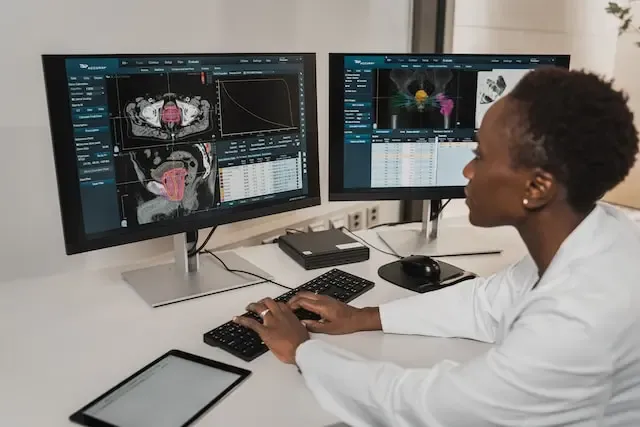
From robots helping nurses with the manual labor to emotion AI - technology can change the way we perceive healthcare - and it is already doing it. If you would ask a specialist to tell you what healthcare will look like in 2035, they would surely mention the impact of new inventions, such as:
- Telemedicine and AI: Combining it with the use of patient portals and artificial intelligence allows physicians to gather information more swiftly and accurately. As a result of this, the treatment gets better and quicker. Generative AI (LLMs) is already actively managing patient inboxes, summarizing clinical notes, and performing ambient voice scribing in real-time across major hospital networks, which lets doctors spend more time treating illnesses and less on administrative tasks.
- Portable monitoring devices: Another type of technology that is already in use are devices such as wristbands which check your heart rate. The growth of such measuring devices will allow doctors to have a constant overview of the elderly patients or those who suffer from chronic diseases. The device will send data to the physician and if they spot any warning signs they will be able to react almost immediately. Plus, patients will not have to attend regular checks if everything will be analyzed through a device!
- Automation of manual labor: Finally, the growth in technology will affect the work of nurses. In the future of healthcare, many manual labors that are currently done by nurses will be operated by machines. This will guarantee patients more detailed care, as the nurses will have more time to spend on each person.
Read more on how does AI impacts healthcare.
Our final takeaway on the future of healthcare
There are many changes coming to healthcare that have already started - whether it’s the change of approach towards the patient, a switch to telemedicine or the growth of technology. All of this builds a new future of healthcare - a more swift, automated and patient-oriented system.
If you are interested in learning more about the organization of work in the healthcare industry, check our article on how to improve EHR documentation.