




Key points:
- AI medical scribes streamline documentation, reduce errors, and enhance efficiency in healthcare workflows.
- Artificial intelligence medical scribes leverage NLP and machine learning to transcribe and organize patient encounters.
- While AI excels at administrative tasks, human scribes provide empathy, contextual understanding, and critical thinking.
- The future of medical scribes lies in collaboration between AI and human expertise to ensure optimal patient care.
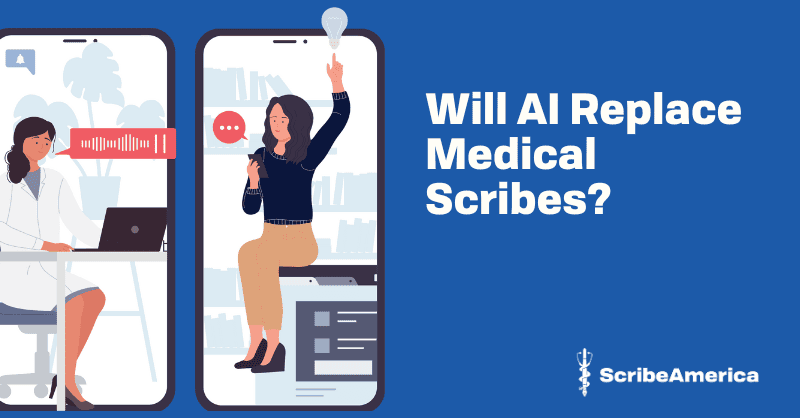
In the ever-evolving landscape of healthcare, the integration of technology has revolutionized numerous facets of medical practice. One such innovation that has gained significant traction is the utilization of AI medical scribes. These digital assistants are designed to streamline administrative tasks, enhance documentation accuracy, and ultimately improve patient care. However, amidst the rise of artificial intelligence in healthcare, many wonder: will AI replace medical scribes?
How are artificial intelligence medical scribes emerging in healthcare?
Artificial intelligence medical scribes are sophisticated software solutions engineered to assist healthcare providers in documenting patient encounters. These AI systems leverage natural language processing (NLP) and machine learning algorithms to transcribe and organize clinical notes efficiently.
By automating documentation tasks, AI medical scribes aim to alleviate the administrative burden on physicians, allowing them to focus more on patient care.
How does an artificial intelligence medical scribe enhance efficiency and accuracy?
One of the primary advantages of an AI medical scribe is its ability to enhance efficiency and accuracy in documentation. Unlike traditional methods, digital tools optimize the workflow through specific benefits:
- Real-time transcription: AI systems can rapidly process vast amounts of spoken information and generate comprehensive clinical notes instantly.
- Minimized human error: These digital assistants are not susceptible to physical fatigue, significantly reducing the risk of clerical inaccuracies in medical records.
By leveraging AI technology, healthcare providers can expedite the documentation process and ensure the long-term integrity of vital patient data.
What are the challenges and limitations of AI scribing?
Will medical scribes be replaced by AI? Despite the promising capabilities of AI medical scribes, several challenges and limitations persist. When evaluating if is ai replacing medical scribes today, consider these factors:
- Potential loss of human touch in patient interactions.
- Lack of empathy and contextual understanding compared to human scribes.
- Integration into existing healthcare workflows requires training and adaptation.
- Healthcare professionals must learn to effectively use AI medical scribes to avoid disruptions.
- Additional resources and training programs, like ScribeAmerica, can help professionals excel in this evolving role. Medical scribe training details.
AI medical scribe vs human scribe
Comparing AI medical scribes and human scribes highlights the complementary strengths of both. AI excels at processing data quickly, generating accurate notes, and handling repetitive administrative tasks, while human scribes contribute interpersonal skills, critical thinking, and empathy during patient encounters. By combining these strengths, healthcare teams can achieve more efficient, precise, and human-centered patient care.
| Feature | AI medical scribe | Human scribe |
| Documentation speed | High, real-time transcription | Moderate, depends on experience |
| Accuracy | Consistent, error-minimized | Variable, human error possible |
| Interpersonal interaction | None | High, empathy and patient engagement |
| Adaptability | Depends on software updates | Flexible, can interpret context |
What is the long-term outlook for human medical scribes?
As AI continues to advance, the role of medical scribes may undergo transformation. While some fear that AI will render human scribes obsolete, others believe that technology will complement rather than replace human involvement in healthcare. Rather than displacing medical scribe jobs entirely, AI may serve as a tool to augment the capabilities of healthcare professionals. Human scribes can focus on tasks that require interpersonal skills and critical thinking, while AI handles routine administrative duties.
Will medical scribes be replaced by ai? Our final takeaway
Are medical scribes being replaced by ai? The advent of AI medical scribes represents a significant advancement in healthcare technology. While these digital assistants offer numerous benefits in terms of efficiency and accuracy, they also pose challenges in terms of maintaining humanistic aspects of patient care. As the healthcare industry navigates the integration of AI, it is essential to strike a balance between leveraging technology to enhance productivity and preserving the human element in patient interactions.
Ultimately, the future of medical scribe jobs lies in synergy between artificial intelligence and human expertise, ensuring optimal patient care in the digital age.
Want to learn more about the healthcare team? Check our article: What is a healthcare team?