




Medical documentation is the backbone of modern healthcare. However, the traditional process of note-taking has long been a tedious task for physicians, often pulling them away from direct patient care.
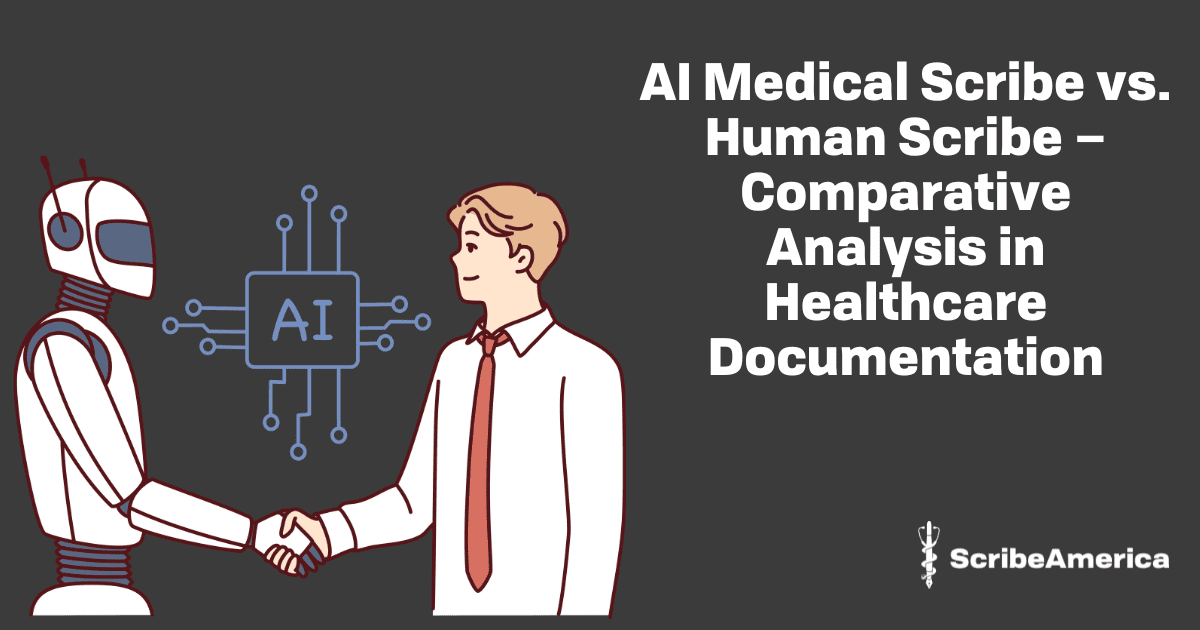
The omnipresence of artificial intelligence inspires us to ask one major question: ai medical scribe vs human – which one better enhances efficiency, accuracy, and workflow in medical settings? Before diving in, it is always helpful to remind ourselves what a medical scribe is and how their role impacts the clinic.
Key Points:
- An AI-powered system provides exceptional speed and cost-effectiveness by generating clinical documentation in real-time without needing breaks.
- Human scribes offer irreplaceable critical thinking, emotional intelligence, and physical adaptability that artificial intelligence simply cannot replicate.
- Modern medical facilities achieve the highest efficiency by using AI as a basic tool while empowering human scribes to handle complex clinical navigation.
AI scribe vs human scribe: speed and efficiency
One of the biggest differences when comparing an ai medical scribe vs virtual scribe or in-person professional is speed. An AI-powered scribe can transcribe and document patient interactions in real time without needing breaks or slowing down under pressure.
On the other hand, a human medical scribe brings adaptability and critical thinking to the table. They can pick up on nuances in conversation, adjust notes based on physician preferences, and even clarify unclear dictations on the spot. While an AI scribe is lightning-fast, a human scribe can provide real-time judgment that a machine still struggles to fully replicate.
Accuracy and context in documentation
When it comes to medical documentation, precision is really crucial. AI scribes leverage natural language processing (NLP) and machine learning to transcribe medical notes. They are trained on vast datasets to recognize medical terminology and structure notes. However, context is where things get tricky. AI models may sometimes misinterpret ambiguous language or fail to capture the subtlety of a physician-patient exchange.
A human scribe, by contrast, understands the true nuances of clinical encounters. While AI is highly sophisticated, a human professional excels at:
- Interpreting subtle tone and non-verbal communication.
- Understanding implied meanings, such as a physician saying, “Let’s keep an eye on this,” which implies close monitoring.
- Providing empathy and physical awareness in a chaotic clinical setting.
In the human vs ai scribe debate, humans still have the absolute upper hand in complex contextual understanding and advanced care navigation.
Cost and accessibility
One of the most significant advantages of AI scribes is cost-effectiveness. Hiring and training a human scribe can be expensive, especially for small or understaffed clinics. AI solutions, once implemented, provide a consistent and relatively lower-cost alternative. They’re also available 24/7, eliminating concerns about shift changes, vacations, or sick days.
However, a human scribe can provide a much more personalized experience. They develop a working relationship with physicians, anticipate documentation needs, and even assist with complex administrative tasks beyond simple note-taking. In a setting where personal touch matters, a human scribe remains invaluable and completely irreplaceable.
Our final takeaway: how to strike the right balance?
The ai scribe vs human scribe discussion isn’t about one completely replacing the other. Instead, it’s about finding the right balance. AI scribes shine in speed, efficiency, and cost savings, while human scribes excel in context, adaptability, and personal touch. Some healthcare facilities may prefer a hybrid model – using AI for basic documentation while human scribes handle more complex cases.
As technology continues to evolve, AI scribes are already sophisticated components of the workflow. However, the role of human scribes won’t disappear; it will simply evolve to focus more on patient care. If you are curious about the long-term future of this career, read our deep dive on will AI replace medical scribes. Rather than seeing it as a rivalry, the best approach is collaboration for a more seamless, efficient, and patient-focused healthcare system.