


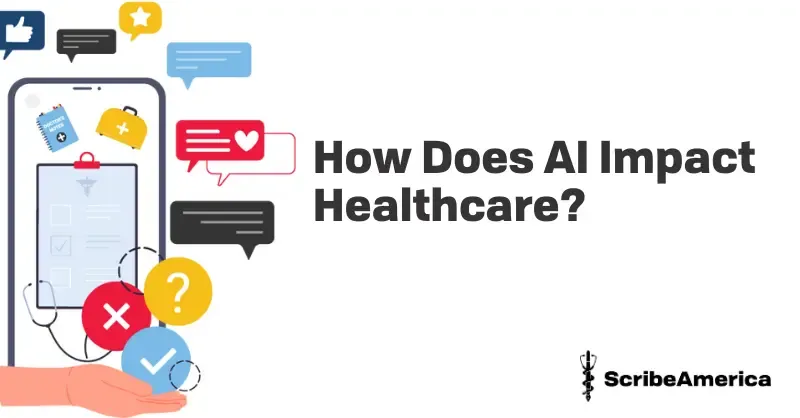


Generative AI has evolved from a trending topic into a deeply integrated, mature component of standard clinical software, transforming various industries, and healthcare is no exception. In fact, AI is already impacting healthcare in significant ways, transforming both clinical and administrative processes. So, how has AI impacted the health industry? Let's explore some of the major ways AI is revolutionizing healthcare today.
Key Points:
- Artificial intelligence actively assists physicians by identifying mental health issues, supporting autism patients, and optimizing medical documentation.
- The integration of this technology leads to highly efficient data analysis, enabling data-driven decisions that improve overall operational efficiency.
- Utilizing modern AI tools actively reduces human error, increases hospital productivity, and allows medical professionals to focus on patient-centered tasks.
How exactly does AI work in healthcare?
Artificial intelligence is used by numerous medical facilities and companies. Its use cases are versatile – AI is introduced both to optimize administrative duties and to improve patient care. So, how does AI impact healthcare currently? Let’s look at some prominent examples.

How can technology help in identifying mental health issues?
One of the most notable examples of the impact of AI in healthcare is in the field of mental health. Multimodal AI emotion detection, which is now natively built into major telehealth platforms, is helping to identify mental health conditions by analyzing voice and image data. This AI can detect emotional cues that may be invisible to the human eye, including:
- Elevated stress levels
- Severe exhaustion
- Early signs of depression
This AI impact on healthcare allows for a more accurate diagnosis and can lead to better treatment outcomes.
What is the role of AI in supporting patients with autism?
Apart from identifying mental illnesses, AI can impact the way physicians communicate with people with autism. The spectrum disorder makes it much more difficult to understand a patient's emotions, since they are often not expressed as we would expect them to be. Yet, with the use of smart bands, it is possible to fully comprehend what an autistic person is feeling. These tools analyze factors such as heart rate or muscle tension to identify the patient’s emotions. They are usually programmed to change the colors based on the wearer’s emotions, thus informing the physician about the feelings of their patient.
How does AI improve workflow and data collection for scribes?
If you know what a medical scribe is, you probably realize how their administrative duties are important for the whole hospital’s integrity. Yet, performing all their tasks manually is strenuous and time-ineffective work. Optimizing this is one of the most prominent benefits of AI in healthcare.
Ambient Clinical Intelligence (ACI) completely automates the documentation drafting process in real-time. Instead of merely proofreading simple transcripts, modern human scribes now focus on complex quality assurance, care navigation, and advanced clinical assistance. As a consequence, the efficiency of the whole process rises, which leads to higher revenue for the hospital or clinic.
If you want to dive deeper into this topic, read our comparison of the AI medical scribe vs human scribe.
Why is streamlining data analysis critical for hospitals?
AI's capability to process and analyze large datasets is another example of how AI helps healthcare. By handling massive amounts of data at once, AI enables healthcare professionals to make data-driven decisions more efficiently. It also aids in improving examinations and enhancing patient care by providing actionable insights that might otherwise be missed. This specific role of AI in healthcare is evident in how it optimizes the management of healthcare facilities, ensuring more effective decision-making.
Our final takeaway: how does AI affect healthcare today?
There are numerous examples of how does AI work in the healthcare industry. Its impact may be seen both in administrative and clinical duties. As such, it is clear that the future of healthcare will continue to introduce more solutions related to artificial intelligence and find further ways to use AI for the benefit of the patients. Curious about long-term career stability in this field? Check out our article discussing will AI replace medical scribes.
Did you like this article? You may also read: What is Medical Billing and Coding? Healthcare in the 21st Century